


Reno Gazette-Journal Reno, Nevada Saturday, July 15, 1972 - Page 5
EVANS ON CHESS
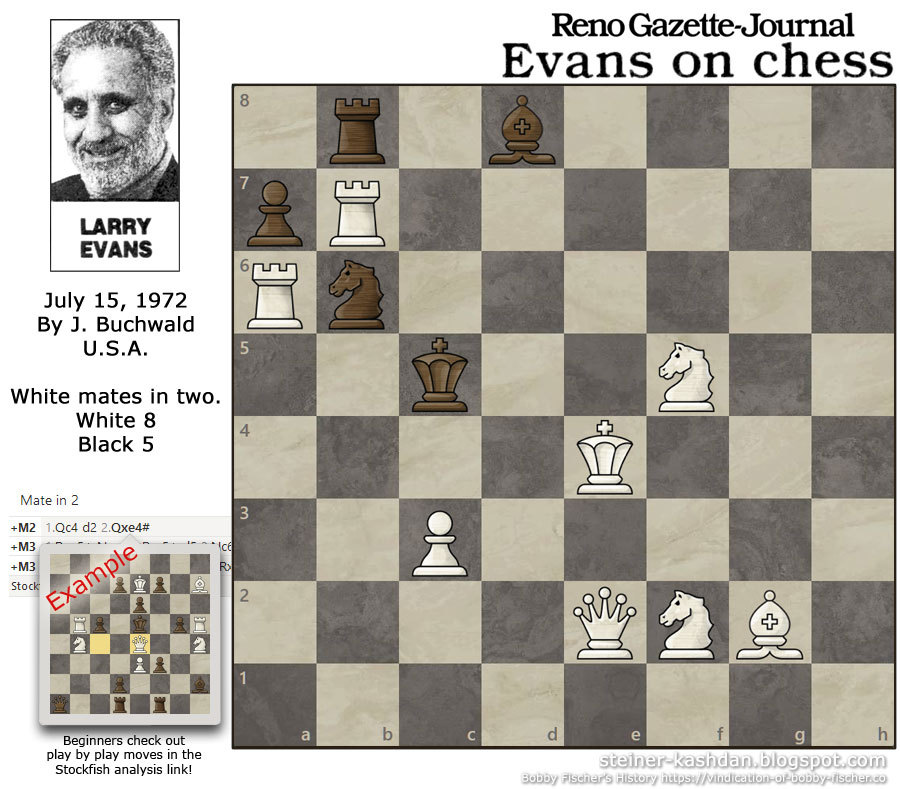
J. Buchwald, U.S.A.
Problem: (07/08/1972) White mates in two.
Stockfish Analysis.

General Principles
Like most games of skill Chess is easy to learn, fun to play, difficult to master. By following these guidelines you should be able to conduct an intelligent game.
1. Always play to dominate the middle of the board. Occupy, attack, or watch the center; the sides and corners are lifeless.
2. Develop all your men fast, not just one or two. The opening is a race for rapid and continuous development. The aim of development is to connect Rooks so that they can occupy central posts for the middle game.
3. Seize open lines!
4. Don't lose time by moving the same piece twice.
5. Avoid early Queen sorties.
6. Develop Knights before Bishops. The course of the game usually suggests the best posts for Bishops. Knights should stand on QB3 and KB3 (not QR3 and KR3).
7. Just move enough center Pawns to free your men. Do not hem in Bishops by pushing center Pawns one square first.
8. Castle early. This brings the King to safety and activates a Rook toward the center.
9. Avoid giving useless checks.
10. Avoid cramped positions — they bear the germs of defeat. When cramped, exchange pieces to get some elbow room.
11. Before deciding on your move, be sure you have countered all of your opponent's threats. Wait!
12. Don't move until you understand the position. Once you touch a piece, you must move it! Don't just push wood, but when you don't know what to do, wait for your opponent to get an idea — it's sure to be bad.
13. Play the board, not the player. Never rely upon a blunder except in desperation. Assume your opponent will find the right move and plan your reply accordingly, Try to see one move ahead —the best one!
14. Never sacrifice material unless you see a way to get it back or force checkmate.
15. Sum up each game and make a mental note of why you either won or lost. If possible, keep a record for future study.
16. Remember, what chess has in common with science and fine art is its utter uselessness (Cassirer).
PROBLEM SOLUTION: 1 K-Q3! threatening 2 R-R5. If 1 … K-N4 2 K-Q4 If 1 … N-B5 2 R-QB6.